Your brand’s reputation can shift in a matter of hours. A single viral tweet, a scathing review, or a competitor’s campaign can change how thousands of people perceive your business—often before you even know it happened. That’s why brand monitoring has moved from a “nice to have” to an operational necessity for companies serious about their online presence.
Brand monitoring services track mentions of your brand across the web, social media, forums, news sites, and review platforms. The right tool gives you real-time visibility into what people are saying, where they’re saying it, and how sentiment is trending over time. This blog breaks down the best brand monitoring services available, what to look for when choosing one, and how platforms like SanMo US can help you take control of your brand narrative.
What Are Brand Monitoring Services—and Why Do They Matter?
Brand monitoring is the practice of tracking online mentions of your business, products, key personnel, and competitors across digital channels. This includes social media platforms, blogs, news outlets, online forums, and review sites like Google and Yelp.
The value goes well beyond reputation management. Brand monitoring services give marketing and PR teams the data they need to respond to customer feedback quickly, catch potential crises before they escalate, and identify trends in how audiences talk about their industry. Companies that monitor their brand proactively are better positioned to build trust, retain customers, and stay ahead of the competition.
Without a monitoring solution in place, you’re essentially flying blind. Negative mentions pile up, unanswered questions erode trust, and competitors move into the spaces you’re ignoring.
Key Features to Look for in a Brand Monitoring Service
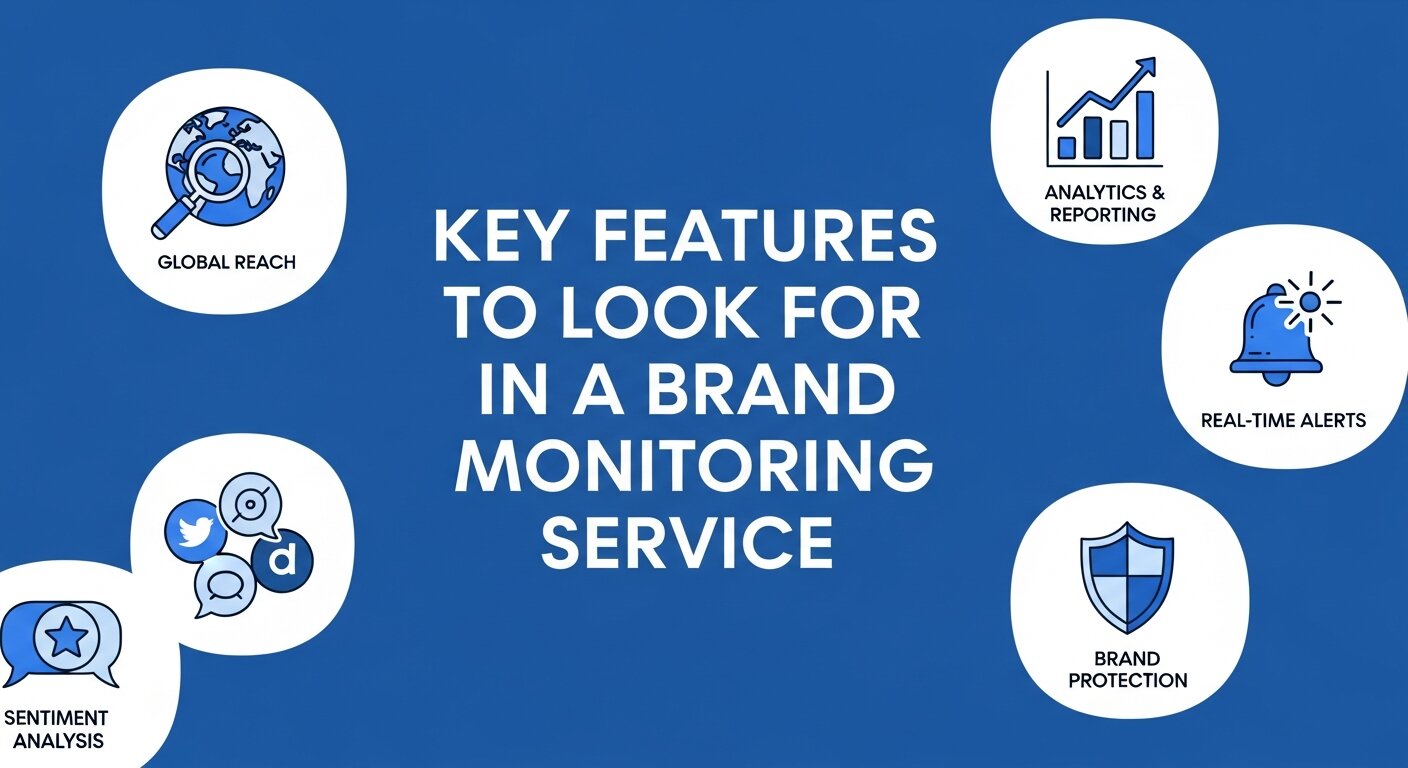 Not all brand monitoring tools are built the same. Before committing to a platform, here are the core features worth evaluating:
Real-Time Alerts and Notifications
Speed matters in reputation management. The best tools deliver real-time or near-real-time alerts when your brand is mentioned, so you can respond quickly—whether that means thanking a happy customer or addressing a complaint before it snowballs.
Sentiment Analysis
Knowing that your brand was mentioned 500 times last week means little without context. Sentiment analysis categorizes mentions as positive, negative, or neutral, giving you a clearer picture of how your audience actually feels.
Multi-Channel Coverage
Your audience doesn’t live on one platform. Look for a service that monitors social media (Instagram, X, LinkedIn, Facebook, TikTok), news outlets, blogs, podcasts, YouTube, and review sites—all from a single dashboard.
Competitor Tracking
Brand monitoring isn’t just about your own name. Tracking competitor mentions reveals gaps in their strategy, highlights emerging trends, and helps you benchmark your share of voice against others in your industry.
Reporting and Analytics
Actionable data should be easy to access and interpret. Strong reporting features—including trend graphs, mention volume, and audience demographics—help teams make informed decisions based on real evidence.
Historical Data Access
Some tools only show recent mentions. Access to historical data lets you analyze how brand perception has evolved over time, which is especially useful for tracking the impact of campaigns or major announcements.
The Best Brand Monitoring Services in 2026
SanMo US
SanMo US is a brand monitoring and online reputation management platform built for businesses that want comprehensive visibility across their digital footprint. SanMo US combines multi-channel monitoring with advanced sentiment analysis, competitor benchmarking, and detailed reporting tools—all in one accessible dashboard.
What sets SanMo US apart is its focus on actionable intelligence rather than raw data volume. Instead of flooding users with thousands of unfiltered mentions, SanMo US helps teams prioritize what actually matters by filtering noise, flagging high-impact mentions, and providing context around trending conversations. For brands managing a complex online presence or operating across multiple markets, this kind of focused insight is invaluable.
SanMo US also supports competitor tracking, allowing brands to monitor rival activity alongside their own mentions. This makes it a strong choice for marketing teams looking to use brand monitoring as a competitive advantage rather than just a defensive tool.
Brandwatch
Brandwatch is one of the most widely recognized names in social listening and brand monitoring. It offers extensive coverage across social media, news, blogs, and forums, backed by powerful AI-driven analytics. Brandwatch is particularly well-suited to enterprise-level organizations with large teams and complex reporting needs.
Its query builder allows for highly customized searches, making it possible to track nuanced brand conversations with precision. The trade-off is that Brandwatch’s interface can be complex for smaller teams, and its pricing reflects its enterprise positioning.
Mention
Mention is a popular choice for small to mid-sized businesses looking for straightforward brand monitoring without a steep learning curve. It tracks mentions across social media, blogs, forums, and news sites, with real-time alerts and a clean dashboard.
Mention’s collaboration features—where teams can assign mentions, leave notes, and track response status—make it useful for PR and customer service teams working together. It doesn’t offer the same depth of analytics as enterprise tools, but it delivers strong core functionality at a more accessible price point.
Meltwater
Meltwater is a media intelligence platform that combines brand monitoring with media relations tools. In addition to tracking online mentions, Meltwater provides access to a large database of journalists and media outlets, making it a strong fit for brands with active PR programs.
Its analytics are robust, covering sentiment, reach, and share of voice. However, Meltwater is priced at the higher end of the market and may offer more functionality than smaller businesses actually need.
Google Alerts
For businesses just starting out with brand monitoring, Google Alerts is a free and simple entry point. You set up keyword alerts, and Google sends you email notifications when those terms appear in new web content.
The limitations are significant—Google Alerts doesn’t cover social media, lacks sentiment analysis, and has no reporting features. Still, as a no-cost supplement to a more comprehensive tool, it has its place.
How to Choose the Right Brand Monitoring Service for Your Business
The best brand monitoring service is the one that fits your specific goals, team size, and budget. Here’s a practical framework for making the decision:
Define your primary use case: Are you focused on reputation management, competitive intelligence, influencer tracking, or campaign measurement? Different tools weight these capabilities differently.
Consider your channel mix: If your audience is primarily on social media, prioritize tools with strong social listening. If press coverage matters more, look for platforms with solid news monitoring and media reach metrics.
Assess your team’s capacity: A feature-rich enterprise platform is only valuable if your team can actually use it. Consider ease of use, onboarding support, and the time your team can realistically dedicate to analyzing data.
Think about scalability: As your brand grows, your monitoring needs will evolve. Choose a platform that can scale with you rather than one you’ll outgrow in 12 months.
Request a demo or trial: Most reputable brand monitoring services, including SanMo US, offer demos or trial periods. Use them to evaluate the interface, data quality, and support responsiveness before committing.
How Brand Monitoring Fits Into a Broader Marketing Strategy
 Brand monitoring doesn’t exist in a silo. When integrated with your broader marketing and customer experience strategy, it becomes one of your most powerful feedback mechanisms.
Customer service teams can use brand monitoring to catch complaints that weren’t submitted through official channels—often, unhappy customers vent on social media before (or instead of) contacting support directly. Catching these mentions early and responding with care can turn a frustrated customer into a loyal advocate.
Content marketing teams benefit from monitoring brand conversations to understand what questions and topics resonate with their audience. If a particular blog post is being discussed across multiple forums, that’s a signal to create more content in that area.
Product teams can mine brand mentions for honest, unsolicited feedback—the kind that focus groups rarely produce. Real-world reactions to product updates, features, or issues offer invaluable input for roadmap decisions.
Finally, brand monitoring data feeds directly into your PR and crisis communication planning. Establishing baselines for mention volume and sentiment means that unusual spikes—positive or negative—are immediately visible, giving your team the lead time to respond strategically.
Integrating Brand Monitoring with SEO and Content Strategy
 Brand monitoring is not just a reputation management tool—it also plays a valuable role in strengthening your SEO and content marketing efforts. Every brand mention, customer question, and online discussion provides insight into the language your audience uses and the topics they care about most. By analyzing these conversations, businesses can uncover new keyword opportunities, identify content gaps, and create articles that directly address customer interests. Positive brand mentions can also lead to valuable backlinks and increased referral traffic, both of which contribute to stronger search engine rankings. When your marketing team combines brand monitoring data with SEO research, content becomes more relevant, improves audience engagement, and supports long-term organic growth. Instead of relying solely on keyword research tools, brands can use real-world customer conversations to guide smarter content decisions that generate measurable business results.
Common Brand Monitoring Mistakes to Avoid
Even the best brand monitoring service won’t deliver results if it’s used incorrectly. One of the biggest mistakes businesses make is tracking only their company name while ignoring product names, executive names, branded hashtags, and common misspellings. Another frequent issue is collecting large amounts of data without creating a process for responding to important mentions. Monitoring should always be paired with clear workflows that assign responsibility for customer support, PR responses, and marketing actions. Businesses should also avoid focusing exclusively on negative feedback, as positive mentions present opportunities for customer engagement, testimonials, and relationship building. Finally, reviewing reports only once a month can cause brands to miss emerging trends or potential crises. Consistent monitoring, regular analysis, and timely action are what transform raw data into meaningful business value.
Measuring the Success of Your Brand Monitoring Strategy
Implementing a brand monitoring platform is only the first step; measuring its effectiveness is equally important. Businesses should establish key performance indicators (KPIs) that align with their marketing and reputation goals. Common metrics include total brand mentions, sentiment trends, share of voice, response time to customer inquiries, review ratings, and engagement levels across different platforms. Monitoring changes in these metrics over time helps organizations evaluate whether their reputation is improving and whether marketing campaigns are generating positive conversations. It’s also beneficial to compare performance against competitors to identify strengths and opportunities for improvement. Regular reporting allows decision-makers to adjust communication strategies, refine customer service processes, and invest in the channels producing the greatest impact. By tracking meaningful performance indicators, brand monitoring evolves from a reactive activity into a strategic tool that supports long-term business growth.
Frequently Asked Questions
What is a brand monitoring service?
A brand monitoring service is a software tool or platform that tracks online mentions of your brand, products, competitors, or industry keywords across channels like social media, news sites, blogs, forums, and review platforms. It helps businesses stay informed about how their brand is perceived online.
Why is brand monitoring important for businesses?
Brand monitoring gives businesses real-time awareness of public perception, enabling them to respond quickly to customer feedback, manage reputational risks, track competitor activity, and measure the impact of marketing campaigns.
How is brand monitoring different from social media listening?
Social media listening is a subset of brand monitoring focused specifically on social platforms. Brand monitoring covers a broader range of sources, including news outlets, blogs, podcasts, and review sites, in addition to social media.
How often should I review brand monitoring data?
For most businesses, a daily review of alerts and a weekly deeper analysis of trends is a reasonable cadence. During a product launch, campaign, or crisis, more frequent monitoring—sometimes real-time—may be necessary.
Is SanMo US suitable for small businesses?
SanMo US is designed to serve businesses of varying sizes, with features that support both focused monitoring for smaller teams and more complex multi-market tracking for larger organizations. The best way to assess fit is to request a demo directly from SanMo US.
What’s the difference between paid and free brand monitoring tools?
Free tools like Google Alerts offer basic keyword tracking with limited channel coverage and no analytics. Paid brand monitoring services provide broader coverage, real-time alerts, sentiment analysis, competitor benchmarking, and reporting features that make the data actionable.
Building a Stronger Online Presence Starts With Listening
 Reputation isn’t built in a single campaign or press release. It accumulates through thousands of small interactions, conversations, and moments of perception. Brand monitoring services give you the visibility to understand those moments in real time—and the intelligence to act on them.
Platforms like SanMo US make that visibility accessible without overwhelming your team with data they can’t use. By centralizing multi-channel monitoring, sentiment analysis, and competitive tracking in one place, SanMo US helps brands move from reactive to proactive—addressing issues before they escalate and doubling down on what’s already working.
Start by auditing what’s being said about your brand today. You might be surprised by what you find—and even more surprised by how much you can do with the right tools in place.