Cash used to be king. But somewhere between the rise of contactless cards, mobile wallets, and real-time bank transfers, the financial landscape shifted—permanently. Digital payment solutions are no longer a convenience reserved for tech-savvy consumers. They’ve become the backbone of modern commerce, reshaping how businesses collect revenue, how consumers spend, and how financial institutions operate at scale.
For companies like SanMo US, this shift represents both an opportunity and a call to action. Businesses that adapt quickly to the evolving payments ecosystem stand to gain a significant competitive edge. Those that don’t risk being left behind by customers who now expect frictionless, secure, and instant transactions as a baseline standard.
This post breaks down what digital payment solutions are, why they matter, what’s driving their growth, and how your business can harness them to stay ahead.
What Are Digital Payment Solutions?
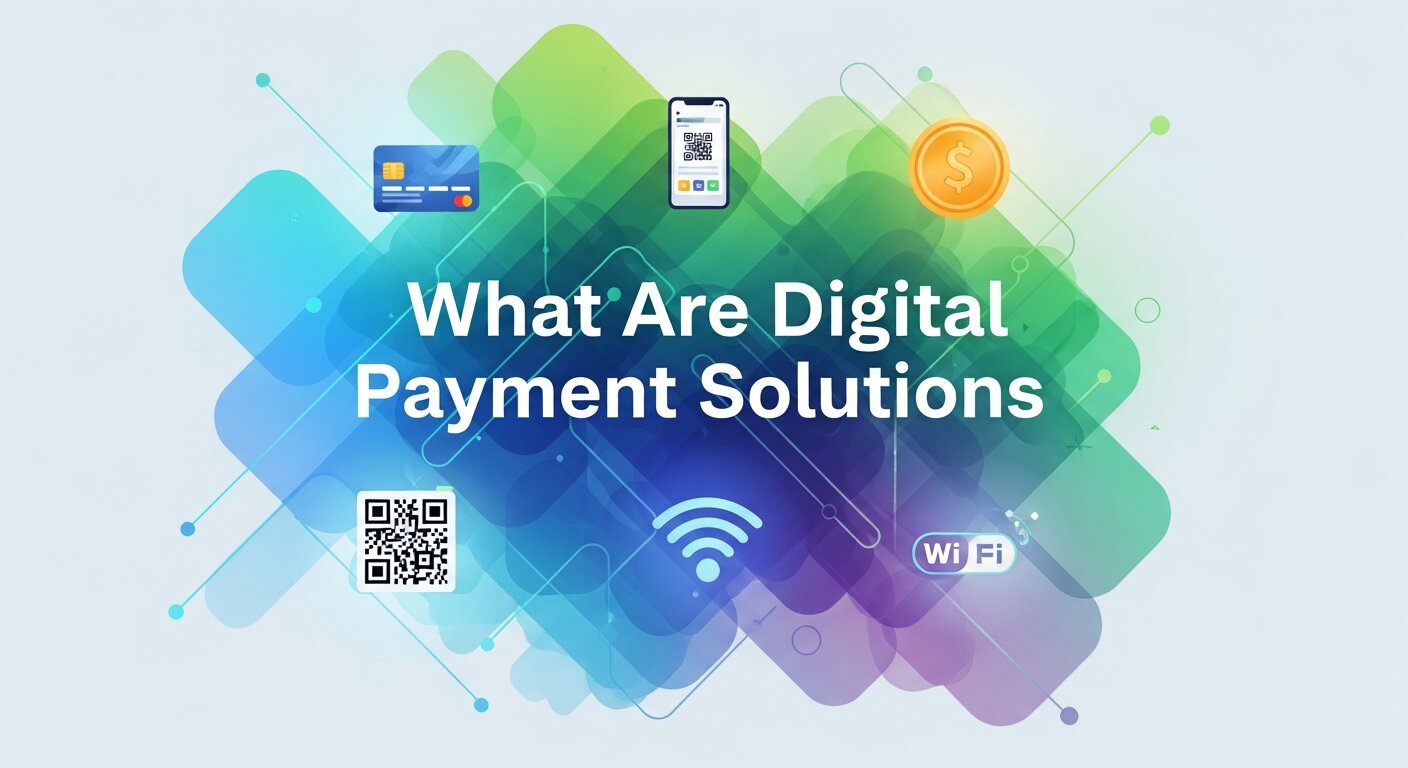 Digital payment solutions are technologies and platforms that enable the electronic transfer of money between parties, without the need for physical cash or paper checks. They span a broad range of tools and infrastructure, including:
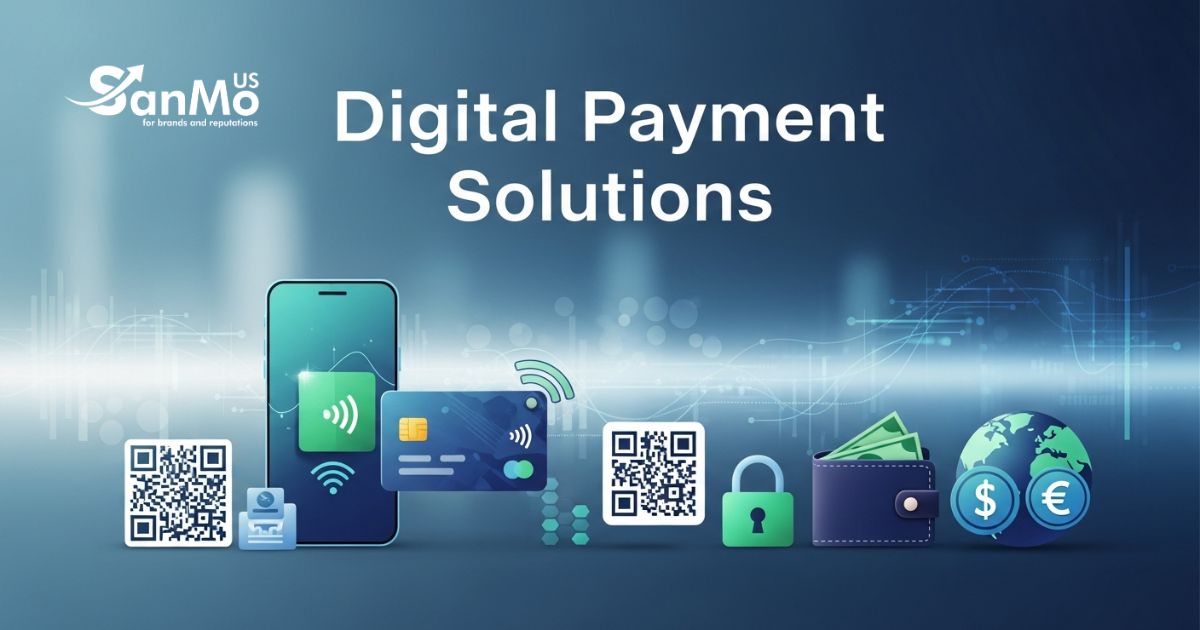
- Point-of-sale (POS) systems that process card and contactless payments in physical stores
- Online payment gateways that handle e-commerce transactions securely
- Mobile wallets like Apple Pay, Google Pay, and Samsung Pay
- Bank-to-bank transfers using ACH, wire, or real-time payment rails
- Buy Now, Pay Later (BNPL) services that offer flexible financing at checkout
- Cryptocurrency and blockchain-based payments
Each of these serves a distinct use case, but they share a common goal: making money move faster, safer, and more efficiently.
Why Digital Payments Are Growing So Fast
The numbers tell a compelling story. Global digital payment transaction values are projected to surpass $14 trillion by 2027, according to Statista. Several forces are fueling this growth.
Consumer Expectations Have Changed
Speed and convenience are now non-negotiable. Consumers don’t want to fumble for cash or wait days for a bank transfer to clear. They want to tap their phone, confirm with a fingerprint, and move on. This behavioral shift—accelerated by the pandemic—has made digital payment adoption a matter of survival for retail and service businesses alike.
E-Commerce Continues to Expand
Global e-commerce sales exceeded $5.8 trillion in 2023. Every online purchase requires a digital payment. As more businesses move online and more consumers shop digitally, the demand for robust, scalable payment infrastructure grows in lockstep. Without a reliable payment gateway, there’s no sale.
Financial Inclusion Is Expanding
One of the most significant—yet often overlooked—drivers of digital payment adoption is financial inclusion. In regions where traditional banking infrastructure is limited, mobile payment platforms have given millions of people access to financial services for the first time. This opens entirely new markets for global businesses.
Regulatory Frameworks Are Maturing
Governments and financial regulators around the world are building clearer frameworks for digital payments. Open banking standards, PSD2 in Europe, and real-time payment initiatives like FedNow in the US are creating more interoperability between financial systems, making it easier for businesses to offer seamless payment experiences.
Key Features to Look for in a Digital Payment Solution
Not all payment solutions are created equal. When evaluating options for your business, these are the features that matter most.
Security and Fraud Prevention
Payment fraud costs businesses over $48 billion globally in 2023. A strong digital payment solution should include end-to-end encryption, tokenization, and multi-factor authentication as standard features—not add-ons. Look for PCI DSS compliance as a baseline requirement.
Speed and Settlement Times
Real-time payments are increasingly the expectation. Solutions that offer instant or next-day settlement give businesses better cash flow visibility and reduce the lag between a transaction and the ability to use those funds.
Integration Flexibility
Your payment solution needs to work seamlessly with your existing tech stack—whether that’s your e-commerce platform, ERP system, or CRM. An API-first architecture makes integration more straightforward and allows for future customization as your needs evolve.
Multi-Currency and Cross-Border Capability
For businesses operating internationally, the ability to accept and settle payments in multiple currencies is essential. Hidden FX fees and slow cross-border settlement can erode margins quickly. Platforms that offer transparent, competitive foreign exchange rates are worth the investment.
Analytics and Reporting
Data is one of the most valuable by-products of digital payments. Detailed transaction data, dispute tracking, and reconciliation tools help finance teams work more efficiently and give leadership a clearer picture of revenue performance.
How SanMo US Approaches Digital Payment Solutions
SanMo US brings a forward-thinking approach to financial technology, helping businesses navigate the complexity of the digital payments landscape with clarity and confidence. Rather than offering a one-size-fits-all product, SanMo US focuses on tailored solutions that align with each client’s operational needs, customer base, and growth trajectory.
Whether a business is looking to modernize its checkout experience, reduce payment processing costs, or expand into new markets, SanMo US provides the infrastructure and expertise to make it happen. Their emphasis on security, compliance, and integration means clients can scale without sacrificing reliability or customer trust.
Real-World Applications Across Industries
Digital payment solutions don’t just live in retail. Their impact is being felt across virtually every sector.
Healthcare
Hospitals and clinics are increasingly adopting digital payment platforms to streamline patient billing. Automated invoicing, flexible payment plans, and online portals reduce administrative burden and improve the patient experience. Faster collections also improve cash flow for healthcare providers.
Real Estate
Property managers and real estate firms use digital payments to collect rent, security deposits, and maintenance fees. Recurring payment automation reduces late payments and eliminates the manual work of chasing paper checks.
Professional Services
Law firms, consultancies, and accounting practices use digital payment solutions to send invoices, accept retainers, and manage trust accounts—all with better audit trails and less administrative overhead.
Hospitality and Food Service
Restaurants, hotels, and event venues rely on fast, reliable payment processing to keep lines moving and guests satisfied. Integrated POS systems that connect front-of-house and back-of-house operations improve efficiency and reduce reconciliation errors.
The Role of AI in the Future of Digital Payments
 Artificial intelligence is rapidly becoming embedded in payment infrastructure. Here’s where it’s having the biggest impact:
Fraud detection: Machine learning models analyze transaction patterns in real time, flagging anomalies that would be impossible for human analysts to catch at scale. This reduces false positives and catches genuine fraud faster.
Personalization: AI enables payment platforms to offer personalized checkout experiences, preferred payment methods, and dynamic pricing based on user behavior.
Dispute resolution: Automated systems can now handle a growing share of chargeback disputes, reducing the time and cost associated with manual review.
Predictive analytics: Businesses can use AI-powered insights to forecast revenue, optimize pricing, and identify emerging trends in customer payment behavior.
The convergence of AI and digital payments isn’t a distant possibility—it’s already reshaping the competitive landscape for payment processors, banks, and businesses alike.
Challenges Worth Addressing
Digital payments come with real challenges that businesses need to plan for.
Cybersecurity threats remain a top concern. As payment technology advances, so do the tactics of bad actors. Regular security audits, employee training, and up-to-date fraud prevention tools are essential.
Regulatory complexity can slow down expansion into new markets. Each country has its own rules around data residency, consumer protection, and payment licensing. Partnering with a knowledgeable provider—like SanMo US—helps businesses navigate this complexity with fewer surprises.
Customer trust must be earned and maintained. Data breaches, payment errors, and poor dispute handling can damage a brand quickly. Transparent communication and robust customer support are non-negotiable.
The Importance of Customer Experience in Digital Payments
 Customer experience plays a crucial role in the success of any digital payment system. Modern consumers expect transactions to be fast, seamless, and secure. A complicated checkout process or slow payment confirmation can lead to abandoned purchases and lost revenue for businesses. Digital payment solutions simplify the buying journey by enabling features like one-click payments, mobile wallet integration, and saved payment methods. These tools reduce friction and allow customers to complete transactions in seconds. In addition, user-friendly interfaces and clear payment confirmations help build trust between businesses and customers. By prioritizing a smooth payment experience, companies can increase customer satisfaction, encourage repeat purchases, and strengthen long-term relationships with their audience.
The Role of Mobile Payments in the Digital Economy
Mobile payments have become one of the fastest-growing segments of the digital payments industry. With smartphones now central to everyday life, consumers increasingly prefer to pay using mobile wallets and payment apps instead of physical cards or cash. Mobile payment solutions allow users to complete transactions quickly using technologies such as QR codes, Near Field Communication (NFC), and biometric authentication. This convenience has made mobile payments particularly popular in retail, transportation, food services, and online shopping. For businesses, adopting mobile payment options can expand their customer reach and improve transaction efficiency. As smartphone adoption continues to rise globally, mobile payments will remain a key driver of innovation and growth within the digital payment ecosystem.
The Impact of Digital Payments on Business Efficiency
 Digital payment solutions significantly improve operational efficiency for businesses of all sizes. Traditional payment methods, such as cash and paper checks, often require manual handling, reconciliation, and time-consuming administrative work. In contrast, digital payments automate many of these processes. Transactions are recorded instantly, making it easier for finance teams to track revenue, manage invoices, and generate financial reports. Automated billing systems, subscription payments, and recurring transactions further reduce the workload for staff. In addition, digital payment platforms often integrate with accounting software, customer relationship management systems, and inventory tools. This level of integration helps businesses streamline workflows, reduce errors, and focus more on strategic growth rather than routine financial administration.
Future Trends Shaping Digital Payment Solutions
The future of digital payment solutions is being shaped by rapid technological innovation and changing consumer expectations. Emerging technologies such as artificial intelligence, blockchain, and biometric authentication are transforming how payments are processed and secured. AI-powered systems are improving fraud detection by analyzing transaction patterns in real time, while blockchain technology offers greater transparency and security for financial transactions. Biometric verification methods, such as facial recognition and fingerprint scanning, are also becoming common in payment authentication. Additionally, the growth of embedded finance and super apps is making payments more integrated into everyday digital experiences. As these trends continue to evolve, businesses that adopt forward-thinking payment strategies will be better positioned to compete in an increasingly digital economy.
Frequently Asked Questions
What is the difference between a payment gateway and a payment processor?
A payment gateway is the technology that captures and encrypts payment information at the point of sale or online checkout. A payment processor is the entity that handles the actual transfer of funds between the customer’s bank and the merchant’s bank. In practice, many modern platforms combine both functions.
Are digital payment solutions suitable for small businesses?
Yes. Many digital payment solutions are specifically designed with small businesses in mind, offering low setup costs, transparent pricing, and user-friendly interfaces. The key is choosing a platform that scales with your business as it grows.
How long does it take to implement a digital payment solution?
Implementation timelines vary depending on the complexity of the integration. A simple payment link or hosted checkout can be live within hours. A fully customized, API-integrated solution for an enterprise environment may take several weeks to deploy.
What should I look for in a payment security standard?
PCI DSS (Payment Card Industry Data Security Standard) compliance is the baseline. Look for solutions that also offer tokenization, 3D Secure authentication, and end-to-end encryption to provide multiple layers of protection.
How are digital payments regulated in the US?
In the US, digital payments are governed by a combination of federal and state regulations, including oversight from the Consumer Financial Protection Bureau (CFPB), the Federal Reserve, and FinCEN. Businesses handling payments must also comply with anti-money laundering (AML) and Know Your Customer (KYC) requirements.
The Time to Modernize Is Now
Digital payment solutions are no longer an upgrade—they’re the infrastructure upon which modern business runs. The businesses that treat payments as a strategic priority, rather than a back-office function, are the ones building lasting competitive advantages.
Whether you’re a growing SME looking to streamline your checkout experience or an enterprise navigating cross-border expansion, the right digital payment partner can make all the difference. SanMo US is positioned to help businesses at every stage move faster, transact smarter, and grow with confidence.
Start by auditing your current payment experience. Identify the friction points your customers face and the inefficiencies your finance team deals with daily. Then build a roadmap toward a payment infrastructure that serves your business today—and scales with it tomorrow.