It takes years to build a reputation, but only a few careless seconds—or a motivated troll—to dismantle it.
If you are a business owner or a public figure, you likely already know the sinking feeling that accompanies a Google Alert notification. You click the link, and there it is: a scathing review, a misleading news article, or a viral social media post tearing apart your hard work. The instinct to panic is natural. You might want to fire back an angry reply, delete your accounts, or call a lawyer immediately.
But reacting emotionally is rarely the right move. In fact, it often acts as gasoline on a fire.
The internet is permanent, but the prominence of specific search results is not. You cannot always control what people say about you, but you can control what people see first. This is the essence of negative content management. It is a strategic, calculated approach to burying damaging narratives and highlighting positive ones.
This guide explores how to navigate the murky waters of online reputation, how to respond to criticism effectively, and when to bring in professionals like SanMo US to handle the heavy lifting.
The High Cost of a Bad Reputation

Before discussing the solution, we must understand the problem. Why does a single negative link matter so much?
The answer lies in consumer psychology. Humans have a negativity bias; we are biologically wired to pay more attention to threats and negative information than positive affirmations. When a potential customer searches for your brand, their eyes will naturally drift toward the one-star review rather than the ten five-star reviews surrounding it.
Data supports this biological theory. Studies consistently show that a vast majority of consumers read online reviews before making a purchase decision. A few negative search results can lead to:
- Lost Revenue: Customers will click away to a competitor with a cleaner digital slate.
- Hiring Difficulties: Top talent researches potential employers. If your company is labeled “toxic” on Glassdoor or in news articles, you will struggle to recruit.
- Partnership Failures: Investors and B2B partners conduct due diligence. Significant negative content is a red flag that can kill deals before they start.
Ignoring the problem is not a strategy. Neither is hoping it goes away. Search engine algorithms tend to favor “clicky” content. Scandal and outrage generate clicks, meaning negative content often rises to the top of search results and stays there unless you actively intervene.
The Three Pillars of Negative Content Management
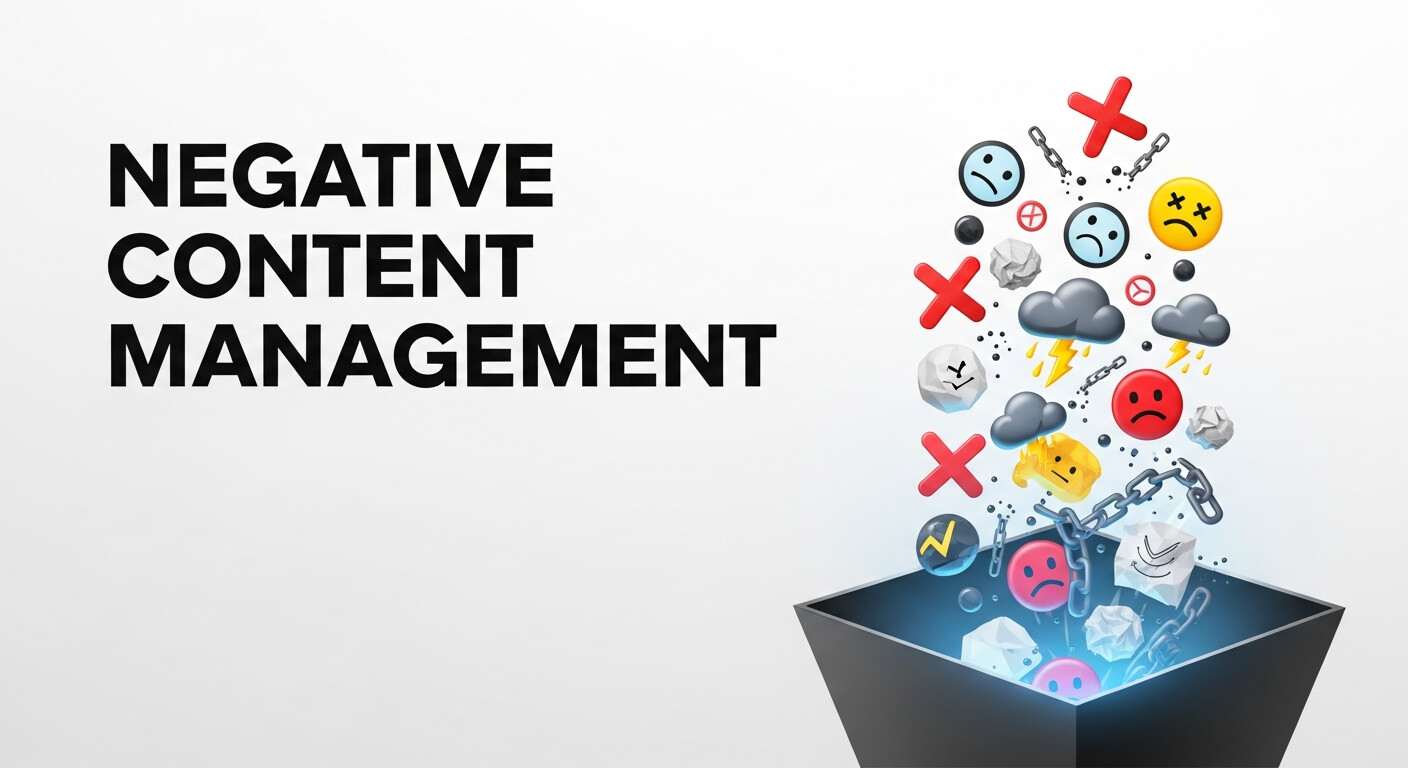
Effective negative content management isn’t about censorship. It is about curation. You are curating the first page of Google to reflect the most accurate, relevant, and positive version of your brand. This process generally falls into three categories: Removal, Response, and Suppression.
1. Removal: The Hardest Path
The first question most clients ask is, “Can we just delete it?”
The answer is usually “no,” but with caveats. Third-party platforms like Google, Yelp, Facebook, and news outlets are fiercely protective of user-generated content. They are generally not liable for what users post (thanks to Section 230 of the Communications Decency Act in the US).
However, removal is possible if the content violates the platform’s Terms of Service (ToS). You can successfully petition for removal if the content includes:
- Hate speech or harassment.
- Personal and confidential information (doxing).
- Provable conflicts of interest (e.g., a competitor writing a fake review).
- Copyright infringement.
If the content is defamatory but doesn’t violate ToS, removal often requires a court order, which is expensive and time-consuming.
2. Response: The Art of De-escalation
If you cannot delete it, you must address it. This applies primarily to reviews and social media comments. A well-crafted response can neutralize a negative review and actually improve your reputation. It shows you are listening and that you care.
The Golden Rules of Responding:
- Cool Down First: Never reply immediately. Wait 24 hours if necessary.
- Acknowledge and Apologize: Even if you think the customer is wrong, acknowledge their frustration. “We are sorry to hear you had this experience” is not an admission of guilt; it is an admission of empathy.
- Take it Offline: Do not fight in the comments section. Offer a direct email or phone number to resolve the issue privately.
- Keep it Brief: Do not write a novel. State your case, offer a solution, and sign off.
3. Suppression: The Core Strategy
This is where the real work of negative content management happens. If you cannot remove a negative link, you must push it onto page two or three of the search results.
The joke in the SEO industry is, “The best place to hide a dead body is page two of Google.” Few users scroll past the first ten results. Suppression involves creating and optimizing high-quality, positive content that outranks the negative content.
Implementing a Suppression Campaign
Suppression is a marathon, not a sprint. It requires a sustained effort to convince search engine algorithms that your new content is more valuable and relevant than the old, negative content. Here is how to build a firewall of positive information.
Audit Your Digital Footprint
Start by Googling your brand name (and variations of it). What shows up? Categorize the results into “Owned” (your website), “Earned” (news mentions), and “Negative.” Identify which negative links are ranking highest. These are your targets.
Claim Your Real Estate
Search engines love authority. One of the easiest ways to occupy space on the first page of results is to claim your profiles on high-authority platforms. Ensure you have active, optimized profiles on:
- Crunchbase
- Twitter (X)
- YouTube
- Medium
Fill these profiles completely. Use your brand name, link back to your main website, and post consistently. These sites have high “domain authority,” meaning they naturally rank well in search.
Create a Content Ecosystem
You need fresh content to signal to Google that your brand is active and relevant. A dormant website is vulnerable.
- Blogging: Publish regular, helpful articles on your website.
- Press Releases: When you have company news, distribute it through reputable PR wires. These often get picked up by news aggregators, flooding the search results with neutral or positive headlines.
- Guest Posting: Write articles for industry publications. This builds your authority and creates positive backlinks to your site.
The Power of Multimedia
Google search results are not just text. They include images and videos. By optimizing images (using alt text) and creating video content (especially on YouTube), you can occupy the “video carousel” and “image pack” sections of the search results, pushing text-based negative articles further down.
When to Call in the Experts
While the strategies above are effective, they require time, SEO knowledge, and consistent execution. For many businesses, handling a reputation crisis internally is overwhelming. This is where a dedicated service provider becomes necessary.
You should consider partnering with experts like SanMo US if:
The Volume is Unmanageable
If you are facing a coordinated attack, a viral cancellation event, or hundreds of negative mentions, manual suppression is impossible. Professional agencies use enterprise-level software to monitor mentions in real-time and deploy assets at scale.
The Content is High-Authority
If the negative content is a piece from a major news outlet like The New York Times or a government website, it will be incredibly difficult to outrank using standard social media profiles. Professionals have networks of high-authority publishing partners to create counter-content that can compete with major news sites.
Legal Intersection
Sometimes, reputation management crosses into legal territory. If you are dealing with defamation, blackmail, or copyright infringement, you need a team that understands the intersection of technology and law. SanMo US can often bridge the gap, working alongside legal counsel to identify the most effective path for removal or de-indexing.
The “Streisand Effect” Risk
The Streisand Effect is a phenomenon where an attempt to hide, remove, or censor information has the unintended consequence of publicizing the information more widely. Amateurs often trigger this by aggressively threatening bloggers or filing baseless copyright claims. Professionals know how to navigate these situations delicately to ensure the negative content quietly fades away rather than exploding into a larger story.
Measuring Success
How do you know if your negative content management strategy is working? It is not always about the total disappearance of the negative link. Success is measured by visibility.
- Rank Tracking: Are the negative links moving down? Moving from position #3 to position #8 is a massive victory.
- Sentiment Analysis: Is the overall sentiment of the first page shifting from “Negative” to “Neutral” or “Positive”?
- Traffic Quality: Are people staying on your website longer? (This indicates they aren’t bouncing back to read negative reviews).
Building a Reputation Firewall
The best time to fix a roof is when the sun is shining. You should not wait for a crisis to start managing your online reputation.
By consistently creating positive content, gathering happy customer reviews, and maintaining active social profiles, you build a “reputation firewall.” When a negative review or article eventually hits (and it likely will), your firewall will prevent it from immediately jumping to the top of the search results.
Think of positive content as a savings account. You build it up over time so that when you have to make a “withdrawal” due to a crisis, you remain solvent.
Frequently Asked Questions
Can I just pay Google to remove a bad search result?
No. Google does not accept payment to alter organic search results. Anyone claiming they have a “backdoor” to Google is likely running a scam. Removal or suppression must be done through legitimate SEO strategies or legal channels.
How long does negative content management take?
It varies depending on the authority of the negative site and the competition for your keywords. Generally, you should expect to see initial movement within 3 to 6 months, but a full suppression campaign can take 12 months or longer to solidify.
Is it illegal to ask customers for good reviews?
It is not illegal to ask for reviews, but “review gating”—asking customers if they had a good experience and only sending the review link to the happy ones—violates the policies of platforms like Google and Yelp. You should ask all customers for honest feedback.
Does changing my business name fix the problem?
Rebranding is a “nuclear option.” It effectively kills all your brand equity and SEO history. While it leaves the negative reviews behind, it also leaves behind all your positive history, and you have to start from zero. It is rarely recommended unless the brand is irretrievably toxic.
What if the negative content is on a “complaint site” like Ripoff Report?
These sites are notoriously difficult because they have high domain authority and rarely remove content. Suppression (burying the link) is usually the only viable strategy for these types of sites.
Taking Control of Your Narrative
Your online reputation is your most valuable intangible asset. In an era where Google is the new business card, you cannot afford to let algorithms or angry strangers dictate your narrative.
Negative content management is not about deception; it is about balance. It ensures that a single bad day, a misunderstanding, or a malicious attack does not define your entire existence. By implementing a smart, proactive strategy—or hiring the right team to do it for you—you can ensure that when the world searches for you, they see the truth of who you are and what you offer.
Don’t let the negativity win. Start building your defense today.