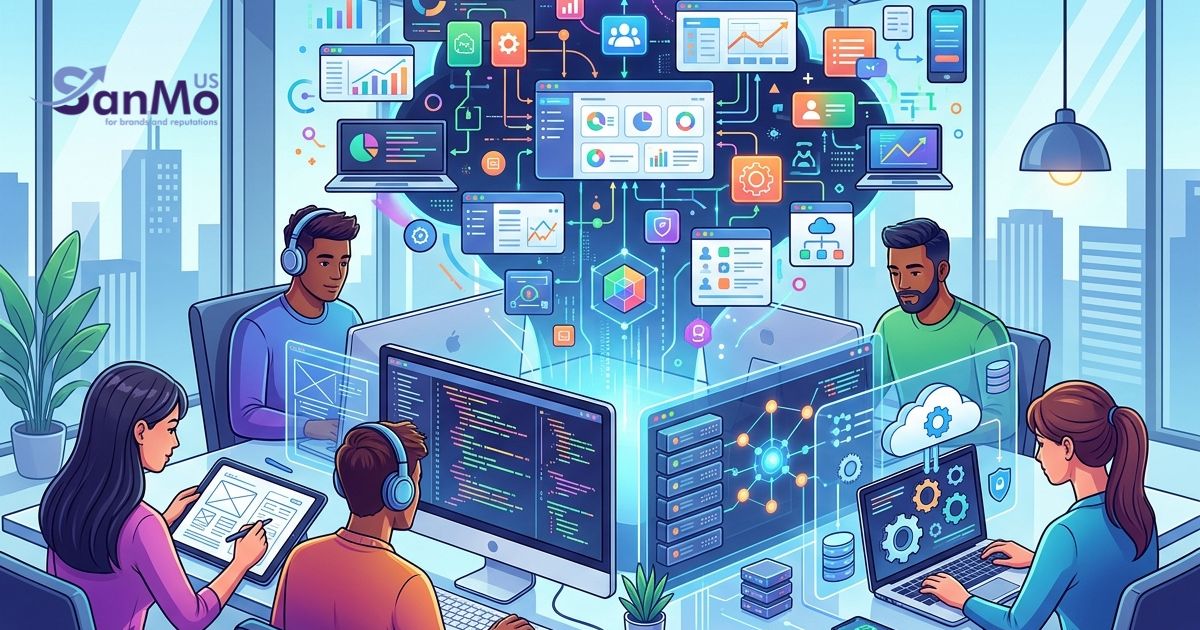
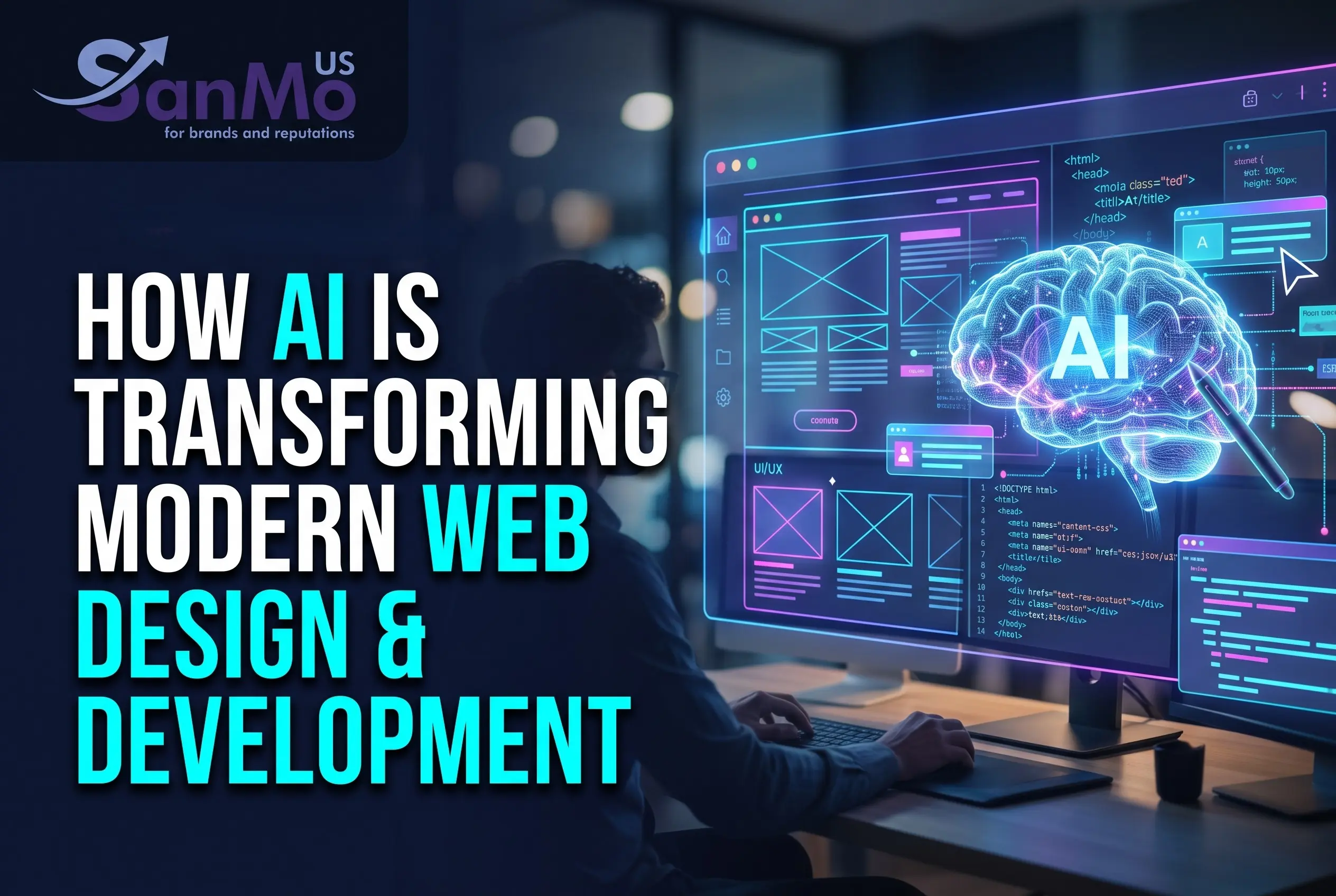
Artificial intelligence is transforming Web Design and Development by helping businesses create smarter, faster, and more personalized digital experiences. From automated website creation to AI-powered user experience optimization, modern technologies are changing how websites are planned, designed, developed, and maintained. For businesses in the United States, adopting AI-driven solutions can improve website performance, strengthen customer engagement, and support long-term digital growth. SanMo US helps businesses explore modern web solutions that align with their digital goals, customer expectations, and evolving technology trends.
Understanding the Role of AI in Web Design and Development
Artificial intelligence is becoming an important part of modern website creation because it can analyze information, automate repetitive tasks, and support better design decisions. AI-powered web development tools help designers and developers work more efficiently while maintaining a strong focus on usability, accessibility, functionality, and business objectives.
How AI Is Changing Traditional Website Creation
Traditional website development often requires extensive manual work, from researching user needs to writing code and testing individual features. AI tools can assist with these processes by generating design suggestions, recommending layouts, identifying coding errors, and supporting content creation. Although professional expertise remains essential, AI can reduce repetitive work and help development teams focus on more complex technical challenges.
Why Businesses Are Adopting AI-Powered Websites
Businesses increasingly need websites that deliver relevant information, respond quickly, and provide convenient customer experiences. AI-powered websites can analyze user interactions, recommend relevant content, and improve customer support through intelligent chatbots. These capabilities help companies create more engaging digital platforms while adapting their websites to changing customer expectations and competitive market conditions.
AI-Powered Website Design and Automated Layout Creation
 AI-powered website design tools can simplify the process of creating attractive and functional web pages. By analyzing design preferences, business requirements, and content structures, these tools can suggest layouts, color combinations, typography, and page arrangements. Designers can use these recommendations as starting points and refine them to maintain brand consistency and deliver a professional website experience.
Faster Website Prototyping and Design Development
AI-assisted prototyping enables designers to explore multiple website concepts without creating every version manually. Teams can experiment with navigation structures, landing page layouts, and visual elements before committing to a final design. This approach can shorten early development stages and make collaboration easier, particularly when businesses need to evaluate several concepts before launching a new website.
Maintaining Brand Identity Through AI Design Tools
AI can help designers generate consistent visual elements and suggest layouts that match a company’s branding requirements. However, businesses still need human oversight to ensure that their website communicates the correct message and reflects their unique identity. Combining automated design suggestions with professional creative direction helps produce websites that remain recognizable, useful, and aligned with business objectives.
How AI Improves User Experience and Website Personalization
User experience optimization is a major advantage of incorporating AI into website development. Intelligent systems can examine browsing behavior, content preferences, and interaction patterns to identify opportunities for improvement. Businesses can use these insights to make navigation clearer, present relevant information, and create personalized experiences that help visitors find what they need more efficiently.
Personalized Content and Recommendations
AI-powered personalization can display relevant content, product suggestions, and service recommendations based on available user behavior data. For example, an online store may recommend related products, while a service website may highlight information that matches a visitor’s interests. Responsible personalization requires appropriate data handling, transparent practices, and compliance with applicable privacy regulations.
Improving Website Navigation and Accessibility
AI can support better website navigation by identifying confusing page structures, suggesting clearer labels, and helping visitors locate information through conversational search. Certain tools can also assist with image descriptions, captions, and accessibility testing. However, automated accessibility checks cannot identify every usability barrier, so human testing and established accessibility standards remain important throughout development.
AI in Website Development, Coding, and Testing
 AI-assisted coding is changing how developers build and maintain websites. Modern tools can suggest code, explain unfamiliar functions, generate basic components, and identify potential errors. These capabilities can improve development efficiency when used appropriately. Developers must still review generated code, test its behavior, and confirm that the final website meets performance, security, and reliability requirements.
Automating Repetitive Development Tasks
AI tools can help automate routine activities such as generating boilerplate code, documenting functions, and preparing initial test cases. This allows developers to spend more time on application architecture, custom functionality, and technical problem-solving. Effective automation depends on selecting appropriate tools and integrating them into a development workflow that includes code reviews and version control.
AI-Powered Website Testing and Error Detection
Website testing helps ensure that pages, forms, navigation, and interactive features work as expected. AI-assisted testing tools can help identify unusual behavior, detect recurring errors, and prioritize potential problems. Developers can also use automated performance testing to examine loading speed and responsiveness. Human verification remains necessary to confirm that fixes work correctly across different browsers and devices.
The Impact of AI on Website SEO and Performance
AI can support search engine optimization by helping website owners understand search intent, organize content, analyze technical issues, and improve page performance. In modern Web Design and Development, integrating SEO considerations from the beginning can create a stronger foundation for organic visibility. Businesses should prioritize useful content, crawlable page structures, fast loading times, and accessible navigation rather than relying entirely on automation.
AI-Driven SEO Analysis and Content Optimization
AI-powered SEO tools can identify keyword opportunities, evaluate content structure, and suggest improvements to titles, headings, and internal linking. They can also help analyze search trends and competitor content. However, automatically generated recommendations should be reviewed for accuracy, relevance, originality, and search intent. Helpful content that addresses real customer needs remains more valuable than publishing large volumes of generic material.
Improving Website Speed and Core Web Vitals
Website performance influences how visitors experience a digital platform. AI-assisted tools can help developers investigate slow pages, evaluate resource usage, and identify optimization opportunities involving images, scripts, and other assets. Developers should measure real performance data and address issues that affect loading speed, interactivity, and visual stability. These improvements can support usability and contribute to a stronger technical SEO foundation.
AI Chatbots and Intelligent Customer Support
AI chatbots are helping businesses provide convenient customer support directly through their websites. These tools can answer common questions, explain services, guide visitors toward relevant pages, and assist with basic lead qualification. For companies operating across different time zones, automated support can provide assistance outside normal business hours while allowing human teams to concentrate on more complicated customer requests.
Generating and Qualifying Website Leads
AI-powered chatbots can ask visitors relevant questions, collect permitted contact information, and direct qualified inquiries to the appropriate sales team. For service-based businesses, this can create a more organized lead generation process. Companies should clearly explain how customer information is collected and ensure that chatbot responses remain accurate, useful, and consistent with their actual services.
Balancing Automation With Human Assistance
Although AI can handle many routine interactions, it cannot replace human judgment in every situation. Visitors may have complex questions, specific requirements, or concerns that require personal attention. An effective customer support strategy provides a clear path to human assistance whenever necessary. This combination helps businesses maintain convenience without sacrificing trust or the quality of customer relationships.
AI Website Security and Data Protection
 Website security is essential for protecting customer information, business operations, and digital reputation. AI-based security solutions can help identify unusual traffic patterns, flag suspicious activities, and support threat detection. However, these systems are not completely reliable and should form part of a broader security strategy that includes secure coding, regular updates, access controls, backups, and appropriate data protection practices.
Identifying Potential Cybersecurity Threats
AI-powered security tools can analyze activity patterns to identify possible attacks, suspicious login attempts, or unusual website behavior. Early detection may help technical teams investigate incidents more quickly. Nevertheless, automated systems can produce false alerts or overlook threats, making continuous monitoring, security testing, and experienced technical oversight necessary for maintaining a dependable website.
Protecting User Privacy and Business Information
Personalized website experiences and AI-powered analytics often depend on data. Businesses must therefore evaluate what information they collect, why they need it, and how it is stored and protected. Privacy-conscious website development should include appropriate consent mechanisms, data minimization, secure processing, and compliance with relevant privacy requirements. These practices help support customer confidence and responsible AI adoption.
Why Businesses Should Choose AI-Ready Web Development Services
An AI-ready website is designed to accommodate evolving technologies without sacrificing stability, usability, or brand identity. Businesses should consider their current operational needs, expected growth, technical resources, and customer expectations before investing in AI features. Professional web development services can help determine which technologies offer genuine value and which additions may introduce unnecessary costs or complexity.
Building Scalable and Future-Ready Websites
Scalable web development allows businesses to expand their website functionality as requirements change. A well-planned architecture can support integrations with customer relationship management systems, analytics platforms, e-commerce tools, and AI-powered applications. Careful planning also helps reduce compatibility issues and unnecessary redevelopment when new features are introduced.
How SanMo US Supports Modern Web Solutions
SanMo US provides web design and development services for businesses seeking a professional online presence. By considering website functionality, responsive design, usability, and business objectives, companies can develop digital platforms that support their broader growth strategies. Businesses exploring AI integration can discuss their requirements with SanMo US and determine which modern website solutions best fit their needs, budget, and long-term plans.
The Future of AI in Web Design and Development
 AI will continue influencing website design, coding assistance, personalization, accessibility, and performance analysis. As these technologies evolve, businesses may gain access to more efficient development workflows and increasingly adaptive digital experiences. However, successful implementation will depend on responsible decision-making, reliable testing, strong security practices, and a clear understanding of customer needs.
Combining Human Creativity With Artificial Intelligence
AI can generate ideas and automate certain tasks, but human professionals provide strategic thinking, creativity, contextual understanding, and ethical judgment. Designers and developers who combine their expertise with AI capabilities can build websites that are both technically effective and meaningful to their audiences. The goal should not be to automate everything but to use technology where it produces measurable value.
Preparing Your Business Website for Future Growth
Businesses can prepare for future developments by maintaining clean website architecture, monitoring performance, following accessibility standards, and reviewing their technology regularly. Rather than adding AI features simply because they are popular, organizations should identify specific problems and measure the results of each implementation. A practical, customer-focused approach helps ensure that innovation supports sustainable digital growth.
Frequently Asked Questions
1. How is AI transforming web design and development?
AI is helping designers and developers automate repetitive tasks, generate layout suggestions, assist with coding, improve website testing, personalize content, and analyze performance. These capabilities can make development more efficient while supporting better user experiences.
2. Can AI build a complete business website?
AI tools can generate website layouts, content drafts, and code for many common features. However, professional review is often necessary to ensure security, functionality, accessibility, brand consistency, and reliable performance.
3. What are the benefits of AI-powered website design?
AI-powered website design can accelerate prototyping, suggest personalized layouts, support design consistency, and help teams explore different concepts. The actual benefits depend on the tools used and the quality of human oversight.
4. Does AI improve website SEO?
AI can assist with keyword research, content analysis, technical SEO checks, and performance optimization. However, strong SEO still requires helpful content, sound technical implementation, and a clear understanding of search intent.
5. Can AI improve website user experience?
Yes. AI can support personalization, conversational search, relevant recommendations, and behavior analysis. Businesses should evaluate these features carefully to ensure they improve usability without compromising privacy.
6. How does AI help with website security?
AI-powered tools can analyze activity patterns, flag suspicious behavior, and assist with threat detection. They work best alongside secure development practices, regular updates, access controls, and human monitoring.
7. Are AI-generated websites mobile-friendly?
AI tools can generate responsive layouts, but mobile compatibility is not guaranteed. Developers should test websites across screen sizes, browsers, and devices to confirm that navigation, content, and interactive features work properly.
8. Is AI expensive to integrate into a website?
Costs vary according to the tools, integrations, complexity, and ongoing maintenance requirements. Businesses can begin with targeted features and expand their investment when measurable benefits justify the additional expense.
9. Why should businesses invest in professional web development services?
Professional web development services help businesses address technical requirements, responsive design, security, performance, accessibility, and long-term scalability. Experienced teams can also evaluate whether AI features align with actual business goals.
10. How can SanMo US help businesses with modern website solutions?
SanMo US offers web design and development services for businesses seeking professional digital platforms. Businesses can explore its services to discuss website requirements, functionality, responsive design, and potential improvements that support their online objectives.
Conclusion
Artificial intelligence is reshaping modern Web Design and Development by improving design workflows, supporting coding, enabling personalization, strengthening testing, and assisting with website security. However, AI delivers the greatest value when combined with human expertise, responsible data practices, and clear business objectives. Companies that adopt suitable technologies and continuously evaluate website performance can create more effective digital experiences. SanMo US can help businesses explore professional web solutions that align with their needs and support long-term online growth.