Every business needs a digital home. Before you launch a product, run an ad, or send a single marketing email, your online presence starts with two foundational decisions: your domain name and your hosting service. Get these right, and everything else becomes easier. Get them wrong, and you could be fighting an uphill battle from day one.
Most business owners treat domain and hosting decisions as a quick checkbox—pick something cheap, set it up once, and move on. But the truth is, these choices quietly shape how customers find you, how fast your website loads, how secure your data is, and ultimately, how well your business performs online. Whether you’re launching a brand-new venture or scaling an established company, understanding what domain and hosting services actually do for your business can change how you think about growth.
This post breaks down the real relationship between domain and hosting services and business growth—covering performance, credibility, security, scalability, and how to choose the right setup for your stage of business. By the end, you’ll have a clear picture of what to look for, what to avoid, and how SanMo US can help you build a digital foundation that’s built to last.
What Are Domain and Hosting Services, and Why Do They Matter?
Before diving into growth strategy, it helps to get clear on what these two services actually are—and how they work together.
A domain name is your website’s address on the internet (e.g., yourbusiness.com). A hosting service is the infrastructure that stores your website’s files and makes them accessible to anyone who types in that address. Think of it this way: your domain is the street address, and your hosting is the building itself.
Neither works well without the other. A strong domain name without reliable hosting leads to a slow, unstable website. Great hosting without a memorable domain makes it harder for customers to find you. Together, they form the backbone of your entire online presence.
For businesses, these aren’t just technical considerations—they’re strategic ones. The right domain and hosting setup directly affects your search engine rankings, your website’s speed, your brand’s credibility, and your ability to scale as your business grows.
How a Strong Domain Name Builds Business Credibility
 Your domain name is often the first impression a potential customer has of your brand. A professional, memorable domain signals legitimacy. A clunky or generic one does the opposite.
Here’s what a strong business domain does for you:
- Builds instant trust: Customers are far more likely to trust a business with a clean, branded domain (e.g., sanmous.com) than one using a free subdomain (e.g., yourbusiness.weebly.com).
- Reinforces your brand identity: A domain that matches your business name makes your brand easier to remember and search for.
- Supports SEO: Keywords in your domain can still carry some weight in search engine rankings, particularly for local and niche markets.
- Enables branded email: With your own domain, you can create professional email addresses, which increases credibility in every client interaction.
Choosing the right domain extension also matters. While .com remains the most recognized and trusted globally, extensions like .co, .io, or industry-specific ones (.agency, .store) can work well depending on your audience and market.
Why Website Hosting Quality Directly Affects Your Revenue
 Slow websites lose customers. This isn’t an exaggeration—it’s a well-documented reality. Studies have shown that a one-second delay in page load time can reduce conversions by up to 7%. For an e-commerce store generating $100,000 a month, that’s $7,000 in lost revenue from a single second of lag.
Your hosting service is the primary driver of your website’s speed. Here’s how different hosting factors affect your bottom line:
Server Speed and Uptime
Uptime refers to the percentage of time your website is live and accessible. Reputable hosting providers guarantee 99.9% uptime or higher. Even a small dip below this can mean hours of downtime per month—hours during which customers can’t reach you, shop with you, or contact you.
Server speed determines how quickly your pages load. Hosting services that use modern infrastructure, SSD storage, and CDN (Content Delivery Network) integration load significantly faster than older, shared environments.
Shared vs. Dedicated vs. Cloud Hosting
Not all hosting is created equal. The type of hosting you choose should match the size and demands of your business:
- Shared hosting: Multiple websites share the same server resources. It’s affordable and works for small or brand-new websites with low traffic.
- VPS (Virtual Private Server) hosting: A middle ground that gives you dedicated resources within a shared environment. Better performance and more control than shared hosting.
- Dedicated hosting: Your website has an entire server to itself. Ideal for high-traffic websites or businesses with specific security requirements.
- Cloud hosting: Resources are distributed across multiple servers, offering flexibility and scalability. Great for businesses with fluctuating or growing traffic.
Choosing the right hosting tier from the start—or knowing when to upgrade—is one of the most impactful decisions a growing business can make.
The Role of Security in Protecting Business Growth
Growth attracts risk. As your website traffic increases and your online transactions grow, so does your exposure to cyber threats. Domain and hosting security features aren’t optional extras—they’re essential business protection.
Key security features to look for in a hosting provider include:
- SSL certificates: SSL (Secure Sockets Layer) encrypts data transferred between your website and your visitors. Websites without SSL display a “Not Secure” warning in browsers—an immediate trust-killer. Google also uses HTTPS as a ranking signal.
- Automated backups: Regular, automated backups ensure that if something goes wrong, you can restore your website quickly with minimal disruption.
- Malware scanning and removal: Proactive scanning catches threats before they cause damage to your site or your customers’ data.
- DDoS protection: Distributed Denial of Service attacks flood your server with traffic to take your site offline. Good hosting providers have safeguards in place to mitigate these attacks.
- Domain privacy protection: When you register a domain, your contact information is stored in a public WHOIS database. Domain privacy protection replaces your personal details with generic contact information, reducing spam and protecting your identity.
SanMo US includes robust security features across its domain and hosting packages, so businesses can focus on growth without constantly worrying about their digital safety.
Scalability: How the Right Hosting Setup Grows With You
One of the most overlooked aspects of choosing a hosting provider is scalability. A plan that works perfectly for a 10-page startup website won’t necessarily handle the demands of a 500-product e-commerce store or a high-traffic blog with thousands of monthly visitors.
Scalable hosting allows you to upgrade your resources—storage, bandwidth, processing power—without migrating to an entirely new platform. This kind of flexibility matters because business growth isn’t always linear. You might experience a sudden surge in traffic after a viral campaign or a product launch, and your hosting needs to handle that without crashing.
When evaluating hosting services, look for:
- Easy upgrade paths between hosting tiers
- Auto-scaling capabilities (particularly with cloud hosting)
- Clear bandwidth and storage limits at each tier
- Responsive technical support to help you navigate growth transitions
Domain and Hosting Services and SEO: The Connection You Can’t Ignore
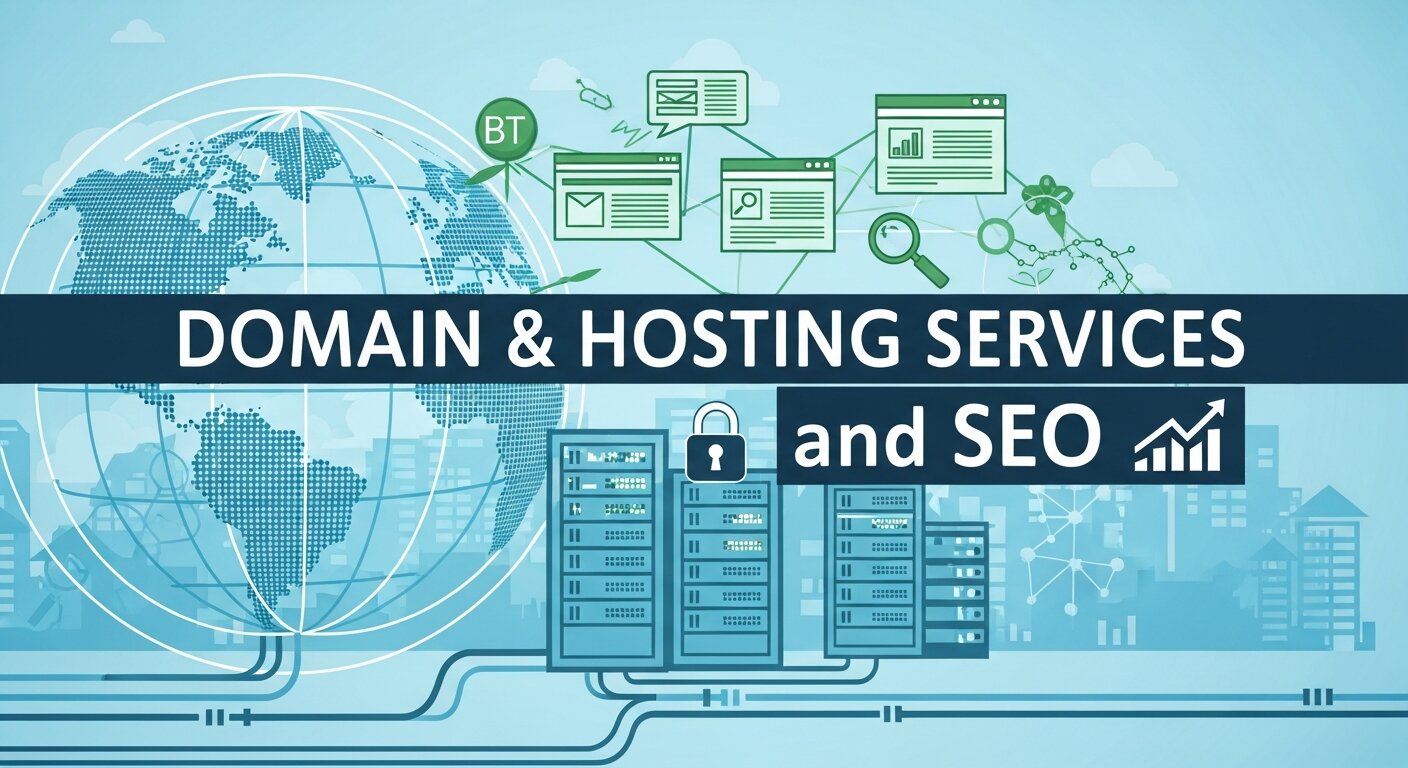 Search engine optimization doesn’t exist in isolation from your infrastructure. Several domain and hosting factors directly influence where your website ranks in search results.
Domain age and history: Older domains with a clean history tend to rank better than brand-new ones. If you’re purchasing an existing domain, check its backlink profile and any past penalties using tools like Ahrefs or Google Search Console.
Server location: Hosting your website on a server close to your primary audience reduces latency and can improve local SEO performance.
Site speed: As mentioned earlier, Google uses page speed as a ranking factor. Fast hosting directly supports better SEO.
Uptime and reliability: Google crawls websites regularly. Frequent downtime can result in pages being dropped from search indexes.
SSL/HTTPS: Google confirmed HTTPS as a ranking signal in 2014, and it remains important today. All modern hosting packages should include SSL certificate support.
For businesses investing in content marketing and SEO, choosing quality domain and hosting services from the start is one of the smartest foundational moves you can make.
How SanMo US Supports Business Growth Through Domain and Hosting
SanMo US offers domain registration and hosting solutions designed with growing businesses in mind. From affordable shared hosting plans for startups to scalable cloud and dedicated options for established brands, SanMo US provides the infrastructure, security, and support that businesses need to compete online.
What sets SanMo US apart:
- Reliable uptime guarantees to keep your business accessible around the clock
- Fast server performance with modern infrastructure for improved speed and user experience
- Bundled SSL certificates to protect your website and boost your SEO
- Scalable hosting plans that grow alongside your business
- Domain registration services that include privacy protection and management tools
- Expert customer support to help you make the right decisions at every stage of growth
Whether you’re just getting started or looking to upgrade your existing setup, SanMo US provides a dependable foundation for your online presence.
How to Choose the Right Domain for Your Business
 Choosing the right domain name is an important step when building a professional online presence. Your domain should be short, memorable, easy to spell, and closely connected to your business or brand. A clear domain makes it easier for customers to remember your website and find you through search engines or direct searches. Whenever possible, choose a trusted extension such as .com, especially if you serve a broad audience. You should also avoid unnecessary numbers, confusing characters, or overly complicated wording that could create mistakes when customers type your address. A well-selected domain can strengthen brand recognition, support professional communication, and provide a stable identity as your business grows. Before registering, check availability, previous domain history, and privacy protection options.
Why Reliable Hosting Support Matters for Growing Businesses
Reliable hosting support becomes increasingly important as a business website grows. Technical issues such as downtime, slow loading, security problems, or configuration errors can interrupt customer access and affect business performance. A dependable hosting provider should offer responsive support that can help resolve problems quickly and guide you when your website requires additional resources. Good support is especially valuable when upgrading hosting plans, managing backups, improving security, or handling unexpected traffic increases. Businesses should consider providers that offer multiple communication channels, knowledgeable technical teams, and assistance throughout the hosting lifecycle. With reliable support in place, business owners can spend less time troubleshooting infrastructure and more time focusing on customers, marketing, and growth. Strong technical assistance also makes it easier to maintain a stable and professional online presence over time.
Frequently Asked Questions
What is the difference between a domain name and web hosting?
A domain name is your website’s address on the internet (e.g., yourbusiness.com), while web hosting is the service that stores your website’s files and makes them accessible online. You need both to have a functioning website—your domain directs visitors to your site, and your hosting serves the content to them.
How do domain and hosting services affect SEO?
Domain and hosting services impact SEO in several ways, including site speed, server uptime, server location, HTTPS/SSL status, and domain age. A fast, reliable, and secure hosting setup supports better search engine rankings, while frequent downtime or a slow server can negatively affect your visibility in search results.
What type of hosting is best for a growing business?
For small businesses and startups, shared hosting is typically a cost-effective starting point. As traffic and resource demands increase, upgrading to VPS or cloud hosting offers better performance and scalability. Dedicated hosting is best suited for high-traffic websites with specific performance or security requirements.
Do I need an SSL certificate for my business website?
Yes. An SSL certificate encrypts data between your website and visitors, protects sensitive information, and displays the padlock icon in browsers. Without it, browsers may flag your site as “Not Secure,” which damages trust and can hurt your search rankings. Most reputable hosting providers, including SanMo US, include SSL certificates with their hosting packages.
How often should I review my hosting plan?
It’s a good practice to review your hosting plan annually, or whenever you experience significant changes in website traffic, storage needs, or business activity. If your site is loading slowly, experiencing downtime, or you’re running out of storage, it may be time to upgrade to a higher-tier plan.
Can I transfer my domain to SanMo US if I already have one?
Yes. Most domain registrars, including SanMo US, support domain transfers from other providers. The process typically involves unlocking your domain at your current registrar, obtaining an authorization code, and initiating the transfer. SanMo US’s support team can guide you through the process to ensure a smooth transition.
Building a Digital Foundation That Lasts
Domain and hosting services aren’t glamorous topics. They don’t get the attention that social media strategies or paid ad campaigns do. But they underpin everything. Every click, every sale, every customer interaction your business has online runs through your domain and your hosting infrastructure.
The businesses that grow fastest online treat these decisions seriously from day one. They choose domains that reinforce their brand, invest in hosting that matches their performance needs, prioritize security, and build on infrastructure that can scale with them.
If you’re ready to build a stronger digital foundation, explore SanMo US domain and hosting services today. The right setup doesn’t just support your business—it accelerates it.