Brands spent over $21 billion on influencer marketing in 2023, and that number keeps climbing. The reason? Creator partnerships work. They reach audiences with a level of authenticity that traditional advertising simply can’t replicate. But running an effective influencer marketing campaign is more complex than it looks—finding the right creators, negotiating contracts, tracking performance, and scaling results all require real expertise.
That’s where influencer marketing services come in. Whether you’re a growing DTC brand trying to break through the noise or an established company looking to diversify your marketing mix, partnering with a team that specializes in creator marketing can be the difference between a campaign that flops and one that drives measurable ROI.
This guide breaks down everything you need to know about influencer marketing services: what they include, how to evaluate providers, what success looks like, and how Sanmo US helps brands build creator partnerships that actually deliver.
What Are Influencer Marketing Services?
Influencer marketing services refer to the end-to-end support that agencies and platforms provide to help brands plan, execute, and measure creator-driven campaigns. These services go well beyond simply connecting a brand with a popular social media account.
A full-service influencer marketing offering typically includes:
- Influencer discovery and vetting — Identifying creators whose audience demographics, content style, and engagement rates align with your brand
- Campaign strategy and brief development — Defining goals, messaging, deliverables, and timelines
- Contract negotiation and compliance — Managing usage rights, disclosure requirements, and payment terms
- Content review and approvals — Ensuring creative assets meet brand guidelines before going live
- Performance tracking and reporting — Measuring reach, engagement, conversions, and return on investment
- Relationship management — Building long-term creator partnerships rather than one-off transactions
The depth of service varies depending on the provider. Some agencies handle everything from strategy to reporting. Others focus on a specific piece of the puzzle, such as creator discovery or paid amplification of organic content.
Why Brands Are Doubling Down on Creator Partnerships
 Consumer trust in traditional advertising has eroded significantly over the past decade. Banner ads get ignored, TV spots get skipped, and branded content often feels disconnected from real life. Creators, on the other hand, have built genuine relationships with their audiences—and that trust transfers.
When a creator authentically recommends a product to their community, it carries weight. According to a study by Matter Communications, 69% of consumers trust influencer recommendations over branded content directly from companies. That figure jumps even higher among younger demographics, particularly Gen Z and millennials, who are more likely to make purchasing decisions based on social proof.
Beyond trust, influencer marketing also delivers versatility. Brands can activate creators across every stage of the funnel—building awareness through broad-reach campaigns, driving consideration through tutorials and reviews, and converting customers through discount codes and affiliate links.
How to Choose the Right Influencer Marketing Service Provider
Not all influencer marketing agencies are built the same way. Here’s what to evaluate before signing a contract.
Does the agency have relevant industry experience?
Look for providers who have worked with brands in your category. An agency that specializes in beauty and lifestyle campaigns may not be the right fit for a B2B software company. Ask for case studies and references from brands with similar audiences and goals.
What does their influencer network look like?
The quality of an agency’s creator relationships matters more than the size of their database. Ask whether they work with creators on a recurring basis or simply pull from a marketplace. Long-term creator relationships tend to produce more authentic content and smoother campaign execution.
How do they measure success?
Strong influencer marketing services are built around data. Your provider should offer transparent reporting on key performance indicators, including reach, impressions, engagement rate, click-through rate, and conversions. If an agency can’t clearly explain how they’ll demonstrate ROI, that’s a red flag.
What’s their approach to compliance and disclosure?
FTC guidelines require that influencers clearly disclose paid partnerships. A reputable agency will have processes in place to ensure creators meet these requirements on every post—protecting both the brand and the creator from potential legal exposure.
Micro, Macro, and Mega Influencers: Which Tier Is Right for Your Campaign?
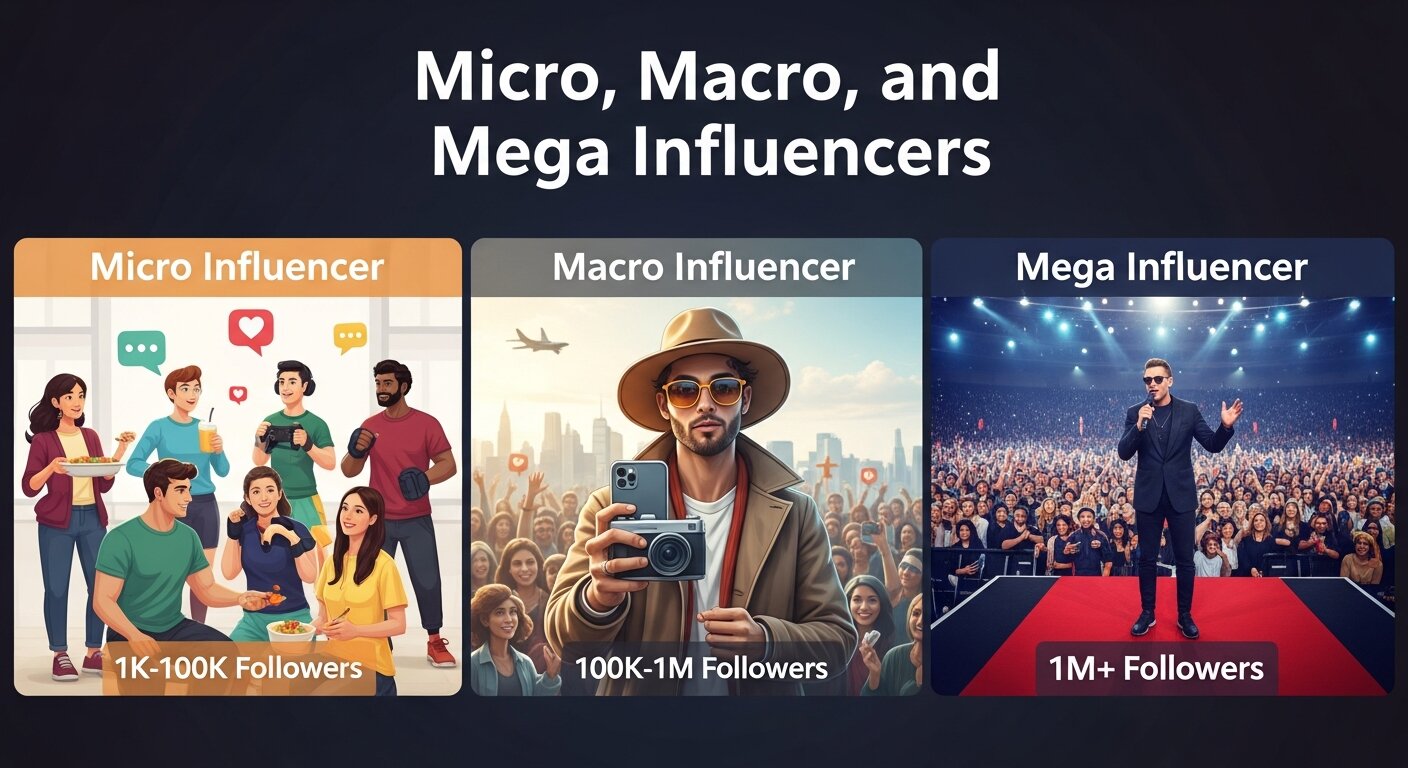 One of the most important strategic decisions in influencer marketing is choosing the right creator tier. Each tier comes with distinct trade-offs in cost, reach, and engagement.
Micro-Influencers (10K–100K followers)
Micro-influencers typically generate the highest engagement rates of any tier. Their audiences are niche and loyal, which makes them particularly effective for brands targeting specific communities—fitness enthusiasts, home cooks, sustainability advocates, and so on. Campaigns with micro-influencers are also more cost-efficient, allowing brands to work with multiple creators simultaneously.
Macro-Influencers (100K–1M followers)
Macro-influencers offer a middle ground between reach and relatability. They’re a strong choice for brands looking to drive awareness at scale without the premium price tag of celebrity partnerships. Their content tends to be more polished, but engagement rates are typically lower than micro-creators.
Mega and Celebrity Influencers (1M+ followers)
Top-tier creators deliver massive reach in a short period of time. They’re particularly effective for product launches, brand repositioning, and campaigns that need cultural impact. The trade-off is cost—celebrity partnerships can run into six figures—and authenticity, which can feel diluted at this scale.
Most successful influencer marketing strategies blend tiers, pairing a smaller number of macro-influencers for broad awareness with a larger network of micro-creators to drive engagement and conversion.
What Does a Successful Influencer Campaign Look Like?
Success in influencer marketing isn’t defined by vanity metrics. A campaign that racks up millions of impressions but doesn’t move the needle on sales or brand sentiment isn’t delivering real value.
Effective influencer marketing services align campaign goals with measurable outcomes from the start. Here’s what that looks like in practice:
For awareness campaigns, the focus is on reach, impressions, and share of voice. Are new audiences being exposed to your brand? Are creators generating conversation around your product?
For consideration campaigns, engagement metrics take center stage—comments, saves, shares, and time spent watching video content. These signals indicate that the content is resonating and driving genuine interest.
For conversion campaigns, tracked links, discount codes, and affiliate structures allow brands to directly attribute sales to specific creators. This level of attribution is increasingly important as marketing budgets face greater scrutiny.
How Sanmo US Approaches Influencer Marketing Services
Sanmo US brings a strategic, data-driven approach to influencer marketing that prioritizes measurable results over vanity metrics. The Sanmo US team works closely with brands to understand their audience, competitive landscape, and campaign objectives before identifying creator partners.
Rather than relying on volume—blasting outreach to hundreds of creators and hoping something sticks—Sanmo US focuses on intentional matchmaking. Every creator partnership is evaluated for audience alignment, content quality, and authentic fit with the brand. This approach consistently produces higher engagement and stronger conversion performance than spray-and-pray tactics.
Sanmo US also takes a long-term view of creator relationships. One-off posts have their place, but the most impactful influencer marketing builds creator advocates who genuinely believe in the brand and communicate that belief to their audience over time. This repeat-exposure model mirrors how word-of-mouth actually works—and it drives results that compound.
From campaign ideation to performance reporting, Sanmo US manages every element of the process so brands can focus on what they do best while their creator partnerships do the work.
The Role of Content Amplification in Influencer Marketing
Many brands leave significant value on the table by treating influencer content as organic-only. Creator-generated content is highly versatile and, when used strategically, can extend well beyond its original post.
Paid amplification (also called “whitelisting” or “dark posts”) allows brands to run paid social ads using creator content directly from the creator’s handle. These ads consistently outperform branded creative in click-through rates and cost per acquisition because they retain the look and feel of organic social content.
Content repurposing means using influencer assets across other marketing channels—email campaigns, landing pages, product pages, and out-of-home advertising. A single well-produced creator video can fuel an entire month of multi-channel content.
Influencer marketing services that incorporate an amplification strategy help brands extract far greater return from every dollar spent on creator partnerships.
Is Influencer Marketing Right for Your Brand?
 Influencer marketing delivers strong results for a wide range of business types, but it’s not a one-size-fits-all solution. It tends to work best for brands with a clear visual identity, a defined target audience, and products or services that lend themselves to demonstration or storytelling.
If your product is highly technical, heavily regulated, or primarily B2B with a narrow buying committee, influencer marketing may play a supporting role rather than a primary channel. In these cases, targeted micro-influencer campaigns in professional communities—LinkedIn creators, industry podcasters, niche YouTube channels—can still drive meaningful results.
The most important factor is alignment: the right creator, reaching the right audience, with content that genuinely reflects the brand’s value proposition.
Leveraging User-Generated Content for Long-Term Brand Growth
Influencer campaigns create more than immediate engagement—they generate valuable user-generated content (UGC) that continues delivering results long after the campaign ends. Authentic photos, videos, reviews, and testimonials created by influencers can be repurposed across websites, social media, email marketing, paid advertising, and product pages to strengthen brand credibility. Unlike traditional branded content, UGC feels more genuine because it reflects real experiences and trusted recommendations. Businesses that strategically organize and reuse creator content maximize their marketing investment while maintaining consistent messaging across channels. High-quality influencer-generated assets also improve customer trust, increase conversion rates, and support long-term brand storytelling. By integrating UGC into a broader digital marketing strategy, brands can build stronger customer relationships, extend campaign value, and create sustainable growth through authentic, community-driven content.
Frequently Asked Questions
What do influencer marketing services typically cost?
Pricing varies widely based on the scope of services, campaign complexity, and creator tier. Micro-influencer campaigns can start in the low thousands, while full-service campaigns involving macro or celebrity creators can range into six figures. Most agencies offer project-based or retainer pricing—ask for a detailed breakdown before committing.
How long does it take to see results from influencer marketing?
Awareness and engagement results are often visible within days of a campaign going live. Conversion results, particularly for higher-consideration purchases, typically require more time and multiple touchpoints. Most brands see meaningful ROI data within 30–90 days of campaign launch.
What’s the difference between an influencer marketing agency and a platform?
An influencer marketing agency provides strategic guidance, campaign management, and hands-on creator relationships. A platform is primarily a software tool that helps brands discover and communicate with creators, often with less strategic support. Many brands benefit from combining both—using a platform for discovery and an agency for strategy and execution.
How do I know if an influencer is a good fit for my brand?
Beyond follower count, evaluate audience demographics, engagement rate, content quality, and brand alignment. A creator with 50,000 highly engaged followers in your target niche will typically outperform a creator with 500,000 loosely connected followers. Influencer marketing services providers like Sanmo US use a combination of data tools and qualitative judgment to make this assessment.
Can influencer marketing work for small businesses?
Yes. Micro and nano-influencer campaigns are particularly well-suited to small businesses because they offer strong audience targeting at a manageable cost. The key is finding creators whose communities genuinely overlap with your ideal customer profile.
How does Sanmo US measure influencer campaign performance?
Sanmo US tracks performance across the full funnel—reach, impressions, engagement, click-through rates, and attributed conversions. Every campaign includes transparent reporting so brands can see exactly what’s working and where to optimize.
Take Your Creator Partnerships to the Next Level
 Influencer marketing is no longer an experimental budget line. For many brands, it’s now a core growth channel—one that requires the same strategic rigor, measurement discipline, and creative investment as any other marketing function.
Working with an experienced influencer marketing services partner like Sanmo US gives brands the infrastructure, expertise, and creator relationships needed to run campaigns that perform. The result is more than visibility. It’s trust, community, and a direct line to the audiences that matter most.
Ready to build creator partnerships that move the needle? Connect with the Sanmo US team to start the conversation.